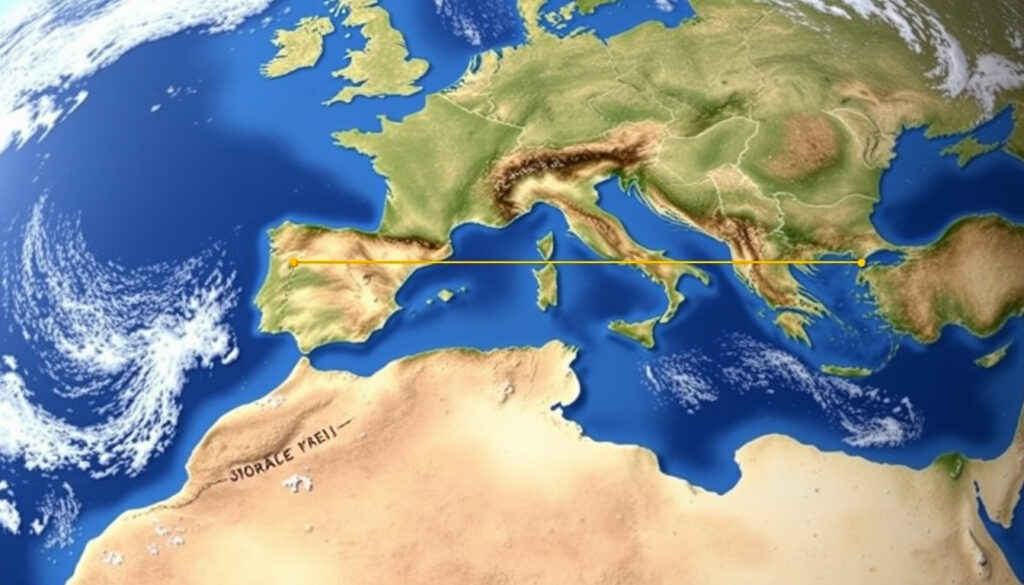
Is Israel in Europe – Definitive Geographic Answer
The question of whether Israel is in Europe comes up frequently in online searches, fueled by its participation in European cultural events and sports leagues. The short answer is no: geographically, Israel is located in Asia. This article explains the facts behind the location, the reasons for the confusion, and what authoritative sources say.
Is Israel in Europe? The Straightforward Answer
Israel is not in Europe. It is a country in Western Asia, on the eastern shore of the Mediterranean Sea. Every standard geographical reference classifies it as part of the Asian continent. The confusion arises not from geography but from cultural, political, and sporting ties that link Israel to Europe.
Asia (Western Asia / Middle East)
Often listed under “Europe” in some contexts (Eurovision, UEFA, etc.)
20,770 sq km (8,019 sq mi)
Asia (mainland), Africa (via Egypt), Europe (across Mediterranean)
Key Facts at a Glance
- Israel is definitively in Asia, not Europe, according to all geographical definitions.
- The confusion arises from Israel’s strong cultural, economic, and political ties with Europe, including membership in European organizations like Eurovision and UEFA.
- Online discussions, including those on Reddit, show mixed perceptions, often influenced by political or cultural views.
- The question “Is Israel in Europe?” is a common search query, indicating persistent user confusion that deserves clear, authoritative clarification.
- Israel’s participation in European sports leagues stems from historical exclusion from Asian federations due to regional politics.
Snapshot Facts: Israel
| Key | Value |
|---|---|
| Official Name | State of Israel |
| Continent | Asia (Western Asia / Middle East) |
| Capital | Jerusalem |
| Area | 20,770 km² (8,019 sq mi) |
| Population (2025 est.) | ~9.7 million |
| Official Languages | Hebrew, Arabic |
| Coordinates | 31°N 35°E |
Is Israel in Europe or Asia?
Geographically, Israel is part of Asia. More precisely, it lies in the Southern Levant region of West Asia, a area commonly referred to as the Middle East. The country shares land borders with Lebanon to the north, Syria to the northeast, Jordan to the east, and Egypt to the southwest. To the west is the Mediterranean coastline.
Sources such as Wikipedia and Encyclopaedia Britannica consistently describe Israel as a country in West Asia or the Middle East. The CIA World Factbook places it in the Middle East, a subregion of Asia. No authoritative geographic source lists Israel as part of Europe.
Why Some Sources List Israel Under Europe
The perception that Israel might be part of Europe stems from non-geographic factors. Israel maintains strong cultural, historical, and economic ties with Europe. A significant portion of the Jewish population in Israel has European ancestry, and the country has close diplomatic and trade relations with the European Union.
In sports, Israel competes in European organizations. It has been a member of UEFA (Union of European Football Associations) since 1994 and participates in the Eurovision Song Contest through its membership in the European Broadcasting Union. These affiliations lead some observers to mistakenly assume a geographic connection.
Israel’s membership in European sports and cultural bodies is a practical response to its exclusion from many Asian regional organizations due to Middle Eastern political dynamics. The country was expelled from the Asian Football Confederation in the 1970s and later integrated into European associations as an alternative.
Where is Israel Located? A Geographical Overview
Israel sits at the eastern end of the Mediterranean Sea, between latitudes 29°N and 34°N and longitudes 34°E and 36°E. It occupies a land bridge that connects Asia, Africa, and Europe, though its territory lies entirely within Asia.
Israel on the Map: Borders and Surrounding Countries
Israel is a relatively small country, stretching about 290 miles (470 km) from north to south and roughly 85 miles (135 km) at its widest point. Its neighbors are Lebanon to the north, Syria to the northeast, Jordan to the east, and Egypt to the southwest. The Mediterranean Sea forms its western border, while the Gulf of Eilat (Aqaba) provides access to the Red Sea in the south.
Key geographical features include the coastal plain along the Mediterranean, the northern and central highlands, the Negev Desert in the south, and the Great Rift Valley to the east, which contains the Dead Sea, the lowest point on Earth’s surface.
A 2013 Israeli Ministry of Foreign Affairs article described the country as lying “at the location of three continents: Europe, Asia, and Africa,” reflecting its position as a historical crossroads. This description, however, does not change its geographic classification: Israel is firmly within Asia.
Israel Area and Land Size
Israel’s total land area is approximately 20,770 square kilometers (8,019 square miles), including about 440 square kilometers of inland water. For comparison, it is slightly larger than the state of New Jersey in the United States and roughly the same size as the country of Slovenia. Despite its modest size, Israel features considerable geographical diversity within its borders.
Why Do Some People Think Israel is in Europe?
The confusion arises from a blend of cultural, political, and historical factors that sometimes overshadow the geographic reality. Many people encounter Israel first through its participation in European events, which shapes their perception.
Cultural and Political Ties to Europe
Israel has deep historical bonds with Europe. A large proportion of Israeli Jews are descendants of immigrants from European countries, and the country has maintained close economic and diplomatic relationships with the European Union. Hebrew and Arabic are the official languages, but many Israelis speak European languages, and European cultural influences are widespread.
Politically, Israel has faced isolation from many of its immediate neighbors in the Middle East since its founding in 1948. This has led it to seek closer partnerships with Europe and the United States. The country participates in several European research and economic programs, such as Horizon 2020, further strengthening the perception of a European connection.
It is important to distinguish between geographical location and organizational membership. Israel is in Asia but participates in European bodies for practical reasons. This dual identity can cause confusion, but for questions of physical geography, the answer remains Asia.
The Reddit Discussion: What Do People Say?
Online forums such as Reddit frequently feature discussions on whether Israel is in Europe. User opinions vary widely. Some commenters point to the strict geographical definition and note that Israel sits in Asia. Others mention the country’s participation in Eurovision and UEFA as evidence that it is treated as part of Europe in certain contexts.
These conversations often reflect broader political and cultural viewpoints. While not authoritative, they show that the question remains a point of genuine curiosity and debate for many people.
Key Events in Israel’s European Associations
- 1948 – Israel declares independence; the country is located in West Asia.
- 1973 – Israel joins the Eurovision Song Contest through its membership in the European Broadcasting Union.
- 1994 – Israel becomes a full member of UEFA (Union of European Football Associations).
- 1999 – Israel participates in the European Union’s Horizon 2020 research program.
- 2024 – Israel continues to compete in European sporting events; online debate about its continental affiliation persists.
What Is Certain and What Remains Unclear About Israel’s Continent?
| Established Information | Information That Remains Unclear |
|---|---|
| Geographically, Israel is located in Asia (Middle East / Western Asia) and is not part of the continent of Europe. This is confirmed by all standard geographic references. | Some global organizations and cultural contexts group Israel with Europe for historical, political, or convenience reasons (e.g., Eurovision, UEFA, UN regional groupings). This creates uncertainty for users encountering mixed signals. |
Why Does the Confusion Persist?
The geographical boundary between Europe and Asia is not a sharp line. The traditional division runs along the Ural Mountains, the Caucasus, and the Turkish Straits, placing the Levant squarely within Asia. Yet Israel’s position as a historical crossroads has made it a meeting point of cultures from three continents.
Israel’s inclusion in European frameworks is pragmatic. It shares linguistic, economic, and cultural links with Europe and has often faced exclusion from regional bodies in the Middle East. In sports and entertainment, Israel competes in European leagues because Asian counterparts have historically excluded it. This dual classification causes confusion, but for authoritative geographic answers, the continent is Asia.
What Do Authoritative Sources Say?
Several reputable sources provide clear statements on Israel’s continental location.
“Israel, officially the State of Israel, is a country in the Southern Levant region of West Asia.”
“Geographically speaking, Israel is located in Asia, and more specifically in its section called the Middle East.”
“Going by strict geography, Israel is located in Western Asia, on the eastern edge of the Mediterranean Sea.”
The United Nations regional groups place Israel in the Asia-Pacific group, though it has also been temporarily included in the Western European and Others Group for practical purposes. This dual UN treatment further illustrates the distinction between geographic fact and organizational convenience.
The Bottom Line: Is Israel in Europe?
No, Israel is not in Europe. It is a country in Western Asia, on the Mediterranean coast. The persistent confusion arises from its strong cultural, political, and sporting ties to Europe, not from its physical location. When the question is about geography, the answer is clear: Israel is in Asia. For further details on the cultural and political dimensions of this classification, see Israel’s Continental Affiliation: Geography, Culture, Sports, and Related Ties.
Frequently Asked Questions
How many countries are in Europe?
There are 44 to 50 countries in Europe depending on how regions are counted. The United Nations recognizes 44 sovereign states, including Russia and Turkey.
Is Palestine a country?
Palestine is recognized as a state by 139 UN member states and is a non-member observer state of the United Nations. Its status is disputed.
What is the Middle East?
The Middle East is a geopolitical region encompassing parts of Western Asia, North Africa, and sometimes the Caucasus. It includes Israel, Palestine, Jordan, Lebanon, Syria, Saudi Arabia, Iran, and others.
Why is Israel in Eurovision?
Israel is a member of the European Broadcasting Union (EBU) and therefore participates in Eurovision. The EBU includes countries from beyond Europe that meet its technical and membership criteria.
Is Israel part of the European Union?
No, Israel is not a member of the European Union. It has a special partnership agreement with the EU and participates in some EU programs.
What continent is Jerusalem in?
Jerusalem is located in Asia, in the West Asia region (Middle East).
Does Israel have land in Africa?
No, all of Israel’s territory is in Asia. It borders Egypt near Africa but does not extend into the African continent.
Why do some maps show Israel as part of Europe?
Some thematic maps, especially those focused on cultural or political topics, may group Israel with Europe for convenience. Physical and political maps consistently place it in Asia.
More related posts
 Red Blood Cell Distribution Width – RDW Test and Normal Levels
 All the Light We Cannot See – Release Date, Cast and Book Guide
 Is Barley Gluten Free – Hordein Risks and Safe Alternatives
 Sold My Car DVLA – Notify, Cancel Tax, and Avoid Penalties
 Waterloo and City Line – Timetable, Map, Status & Facts
 Sam Knows Real Speed – Real vs Advertised UK Speeds
 Devon Aoki – Age, Family, Movies, and What She’s Doing Now
 Lisa Vanderpump – Biography, Net Worth, and TV Career